.svg)




When markets get volatile, it’s tempting to try and outsmart them—jumping out during downturns and back in when things look better. But history and data consistently show that time in the market is far more powerful than timing the market.
The Long-Term Power of Staying Invested
Over the past 124 years, the Australian sharemarket has delivered an average annual return of 13.0%, according to the All Ordinaries Accumulation Index. That includes dividends and reflects both good and bad years. Remarkably, 81% of those years were positive, reinforcing the idea that markets tend to reward long-term investors.
The image below taken from a study by Market Index¹ shows that over the long term the probability having a positive return year is far higher than having a negative year return.
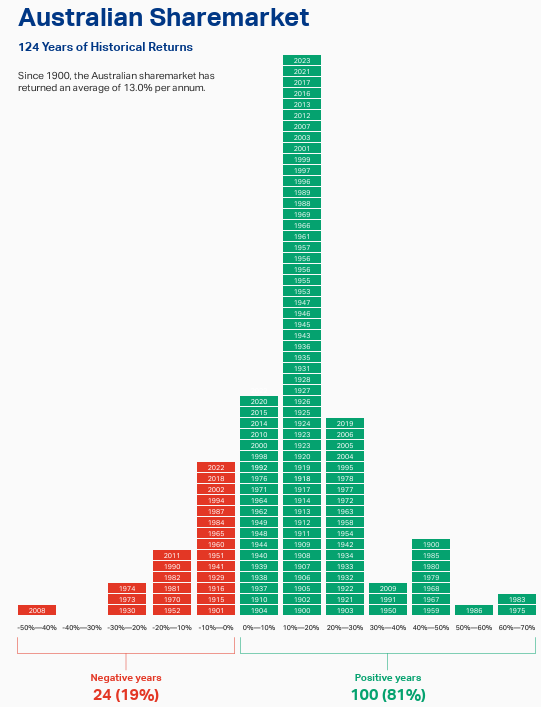
Trying to pick the right time to invest often means missing out on the best days. And missing just a few of those can drastically reduce your returns.
Why Timing the Market Rarely Works
Markets are forward-looking. By the time economic news hits the headlines, it’s often already priced in. Fidelity’s recent investment insights² highlight this with a compelling example: in 2022, Japanese CEOs were pessimistic about growth. Yet in 2023, Japan’s stock market surged nearly 30%, second only to the Nasdaq.
Meanwhile, China’s market struggled despite signs that much of the bad news had already been priced in. These examples show how investor sentiment and actual outcomes often diverge—and why reacting to short-term noise can backfire.
The Cost of Missing the Market’s Best Days
Let’s say you invested $10,000 in the market and stayed fully invested over 20 years. If you missed just the 10 best days, your return could be cut in half. Those best days often come during periods of uncertainty—right when many investors are pulling out.
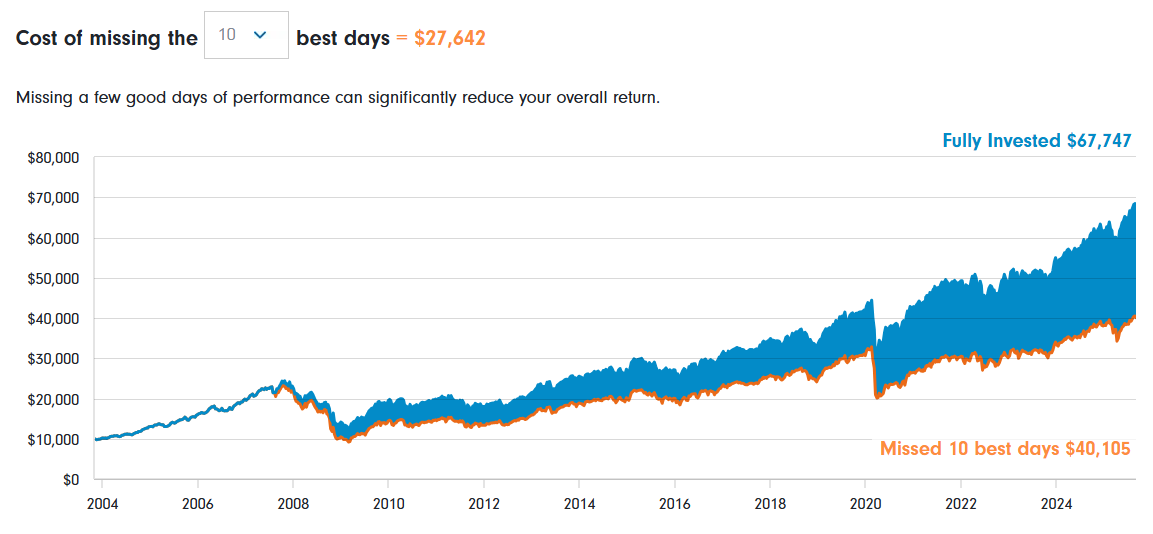
Selling at the top
Selling at a historical high in the market may seem like an obvious sell point. In reality however, it’s nearly impossible to do consistently, as illustrated by the NASDAQ Composite index chart, market peaks are only obvious in hindsight. In real time, they’re clouded by volatility, unpredictable news, and shifting investor sentiment. What looks like a high point could be followed by further gains or a sudden drop. Even seasoned professionals struggle to time their exits perfectly. This uncertainty reinforces the value of a disciplined, long-term investment strategy over trying to pick the perfect moment to sell. As Warren Buffet famously quoted; “The stock market is a device for transferring money from the impatient to the patient”

What Should Investors Do Instead?
- Stay the course: Volatility is normal. Long-term discipline is key.
- Diversify: Spread your investments across asset classes to manage risk.
- Focus on goals: Align your portfolio with your financial objectives, not market headlines.
- Seek advice: A financial adviser can help you stay focused and avoid emotional decisions.
Final Thoughts
Trying to time the market is like trying to predict the weather months in advance—it’s nearly impossible. But staying invested, even through the storms, has historically rewarded patient investors.
If you’re feeling uncertain about your investment strategy, let’s talk. We can help you build a portfolio that’s designed to weather market ups and downs—and keep your long-term goals on track.
- Market Index. (2024). Australian Sharemarket: 124 Years of Historical Returns. All Ordinaries Accumulation Index. Retrieved from the infographic: historical-returns-infographic-2024.pdf.
- Stevenson, T. (2024, February 2). Why it’s time in the market, not timing the market. Fidelity Australia. Retrieved from https://www.fidelity.com.au/insights/investment-articles/why-its-time-in-the-market-not-timing-the-market/
The information in this article is provided as general information only and does not take into account your personal objectives, financial situation or needs. Before acting on any information, you should consider whether it is appropriate for your circumstances and seek professional advice. Past performance is not a reliable indicator of future performance. Any examples or case studies are for illustrative purposes only and do not represent actual or recommended investment outcomes.