.svg)




Investing in the AI revolution
Artificial intelligence (AI) is rapidly transforming industries and the way we live our lives. AI enables computers and machines to problem solve, learn from new information and act independently, potentially replacing the need for human intervention ie. self-driving cars.
More recently we have seen the rise of Generative AI (Gen AI). Anyone who has played around with Chat-GPT will understand the power of Gen AI, which is a technology that can understand and respond to human language at amazing speeds and accuracy with original text, images, video and other content.
Some of the most commonly cited benefits of AI include;
- Automation of Repetitive tasks
- More and faster insight from data
- Enhances decision making
- Fewer human errors
- Available 24/7
- Reduced physical risks
The investment opportunity
As new use cases arise, it seems we are at the tip of the iceberg of AI’s potential. The investment opportunity is massive, as the global economy could add $16 Trillion from advancements in AI by 2030 (Source: Global X).
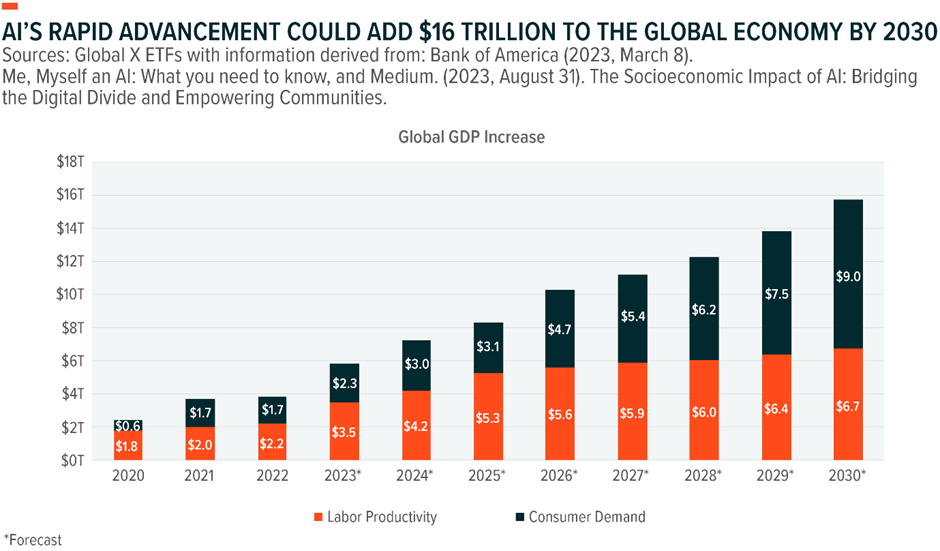
The question then becomes, how to invest in the rapidly growing and evolving space of AI. We have summarised how some of our model portfolio holdings aim to take advantage of the AI revolution through the direct and indirect exposure.
Targeted Exposure: Capturing Key AI Trends
Many businesses are poised to benefit directly through the AI revolution. From suppliers of hardware, software, computing or through massive scale and efficiency gains. We anticipate the following portfolio positions will be beneficiaries of the AI revolution.
Global X FANG+ ETF (FANG): FANG delivers access to multiple disruptive macro-trends arising from technological
advancements, changing demographics and consumer preferences (Source: Global X). Many of the underlying holdings are at the forefront of AI research and development. These companies are driving AI innovation in the following ways:
- NVIDIA: Designs and manufactures GPUs (Graphics Processing Units), which are essential for the high-performance computing required for AI Large Language Model (LLD) training. Their dominance in this space positions them to directly benefit from the growing demand for AI infrastructure.
- Broadcom: Provide a range of semiconductor and infrastructure software solutions, including networking chips and custom ASICs (Application-Specific Integrated Circuits) that are crucial for data centres and AI hardware. As AI workloads increase, the demand for Broadcom’s high-performance networking and processing solutions also rises.
- Microsoft: Microsoft are making significant investments into AI hardware and software, integrating into their Azure cloud platform, Office 365 suite, and other products. AI has driven growth in its cloud business and productivity tools (Co-pilot), and has enabled the development of new AI-powered applications and services.
- Alphabet (Google): Alphabet is a leader in AI research and development, integrating across products and services, including search, advertising, cloud computing (Google Cloud), and autonomous vehicles (Waymo). AI drives improvements in search algorithms, targeted advertising, and the development of new AI-powered products such as Google Gemini, creating significant revenue opportunities.
- Apple: Despite being an early AI laggard, Apple is rapidly catching up to the competition. Hardware is being positioned to scale up artificial intelligence integration. This is anticipated to lead to a device upgrade cycle when the software capabilities catch up. The recent iPhone 16 with its A18 chip is designed to accommodate Apple Intelligence to greatly improve device functionality. Features such as personalized assistance, customized suggestions, tailored notifications, personalized content recommendations, and adaptive settings are expected to enhances the user experience.
- Amazon: Amazon are making significant investment to leverages AI across its e-commerce platform for recommendations, logistics, and customer service. Further, the significant cloud computing division Amazon Web Services (AWS) provides the infrastructure for AI services such as ready-made intelligence for third party applications and workflows.
- Meta Platforms (Facebook): Meta utilizes AI for content moderation, targeted advertising, and enhancing user experiences across its social media platforms (Facebook, Instagram, WhatsApp). AI enables more effective ad targeting, personalized content feeds, and improved platform safety, driving user engagement and ad revenue.
- Crowdstrike: Uses AI and machine learning in its cybersecurity platform to detect and prevent cyber threats in real-time. The increasing sophistication of cyberattacks required advanced AI-powered security solutions such as those offered by Crowdstrike.
Global X Semiconductor ETF (SEMI): Semiconductors are the backbone of AI, providing the processing power necessary for complex calculations and machine learning. This ETF offers exposure to companies involved in semiconductor manufacturing, a critical component of the AI ecosystem.
Global X Cybersecurity ETF (BUGG): As AI becomes more prevalent, cybersecurity becomes even more critical. This ETF provides exposure to companies focused on protecting data and systems from increasingly sophisticated cyber threats, a growing concern in the age of AI.
Life 360 (360): Life360 Inc. (ASX:360) is a San Mateo, California-based technology company that has carved out a niche as the world’s largest family-focused social network, boasting over 50 million monthly active users as of recent reports. Its flagship mobile application provides location-sharing, driving safety, and emergency assistance services, making it a trusted platform for families worldwide. With a vast dataset generated by its extensive user base, Life360 is uniquely positioned to leverage artificial intelligence (AI) to enhance its offerings and create new revenue streams.
Life360’s core strength lies in its massive user base, which has grown to 83.7 million monthly active users (MAUs) as of Q1 2025, a 26% year-over-year increase. This scale generates a wealth of data, including real-time location information, driving behaviour metrics, and user interaction patterns. Such data is a goldmine for AI applications, as it provides the raw material needed to train machine learning models for predictive analytics, personalization, and safety enhancements.
Life360 is already leveraging AI through strategic partnerships and its own feature development. The company’s collaboration with Arity, a leader in driving analytics, utilizes AI to analyse driving behaviour, enabling Life360 to provide detailed safe driver reports and crash detection features. Similarly, Life360’s partnership with Placer.ai, which specializes in AI-driven foot traffic analytics, allows the company to analyse location data to provide insights into user behaviour.
Beyond partnerships, Life360’s in-house features, such as crash detection and place alerts, likely rely on AI for real-time data processing and predictive modelling. For example, crash detection uses sensor data from smartphones to identify accidents and automatically contact emergency services, a process that requires sophisticated AI algorithms to ensure accuracy and timeliness.
The app experience can be tailored to individual users by analysing usage patterns, such as suggesting relevant features or alerts based on family routines. These opportunities can be monetized by leveraging aggregated, anonymized data for targeted advertising or partnerships with industries like insurance, where driving behaviour data can inform premium adjustments, or automotive, where insights can guide vehicle safety improvements.
The company’s freemium model, which combines free basic accounts with premium subscriptions, has driven significant growth. The 2.4 million paying accounts have driven a 32% revenue increase in Q1 2025 to US$103.6m. Analysts project a $1 billion revenue opportunity in the family safety tech sector, driven by Life360’s ability to monetize its data through advertising and partnerships. Life360’s data collection capabilities are a key driver of future growth potential. The company’s acquisition of Tile and Jiobit further expands its data ecosystem, integrating tracking devices for pets, children, and belongings, further expands user engagement.
Goodman Group: Goodman Group (ASX: GMG) is one of the world’s leading industrial property developers and managers, with a presence in Australia, New Zealand, Asia, Europe, the UK and the Americas. Goodman is the largest industrial property group on the ASX, focusing on logistics facilities, business parks and—ever more prominently—data centres. GMG was recently added to our multi-asset share models, recognising its pivotal role in underpinning the infrastructure for tomorrow’s AI‑driven economy.
Goodman’s development pipeline is valued at A$13.7b across 70+ active projects. Key projects include a A$1.4 billion development in Sydney’s Artarmon precinct, as well as new facilities underway in Japan, Hong Kong and Europe. Management has signalled that data centres will represent well over half of the group’s total pipeline within the next few years, reflecting both the accelerating demand for high‑performance computing and Goodman’s strategic land‑bank near major power and fibre corridors.
Goodman contributes to the AI revolution by partnering with hyperscale and cloud providers—such as Amazon Web Services, Microsoft Azure and Google Cloud—to deliver highly resilient, efficient campuses designed for AI workloads. In February 2025, Goodman raised A$4.0 billion via an underwritten placement to finance its next wave of data centre developments, with a combined value expected to exceed A$10 billion. More recently, Goodman established a new Hong Kong data centre vehicle, raising over A$2 billion to manage a portfolio valued at A$4.1b.
McKinsey & Co expects global demand for data centre capacity could rise at an annual rate of between 19% and 27% from 2023 to 2030. This would increase annual demand from 55 gigawatts (GW) to 171-298 GW. GMG is primed to take advantage of this supply deficit by aiming to have 5GW of new data centres underway by June 2026, which, when fully developed, would be worth as much as $100 billion.
With its established land‑bank, integrated development model and deep expertise in high‑density infrastructure, Goodman is exceptionally well‑placed to benefit from—and indeed help enable—the next phase of the AI‑driven digital economy.
Indirect Beneficiaries
Many companies across various sectors will be impacted by AI, even if they aren’t developing the technology directly. Some portfolio holding set to benefit from the AI include:
VanEck MSCI International Quality ETF (QUAL): Focuses on high-quality international companies. These companies are well capitalised to make investments to integrate AI into their operations to maintain their competitive edge.
APA Group (APA): The massive computing power required for AI and data centres creates a growing demand for reliable energy. As a major energy infrastructure provider, APA could benefit from this increased demand, supplying the power needed to fuel the AI revolution.
Conclusion
Our portfolio is positioned to take advantage of the AI revolution both directly and indirectly. It combines targeted exposure to AI-related technologies and trends, and broad market exposure to capture indirect benefits of the AI revolution across various sectors. While some holdings are not direct beneficiaries of AI, they contribute to a well-diversified portfolio positioned to benefit from the long-term growth potential of the AI revolution.
Disclaimer: This blog post is for informational purposes only and does not constitute financial advice. It’s essential to conduct thorough research and consider your investment objectives or speak to your financial adviser before making any investment decisions.